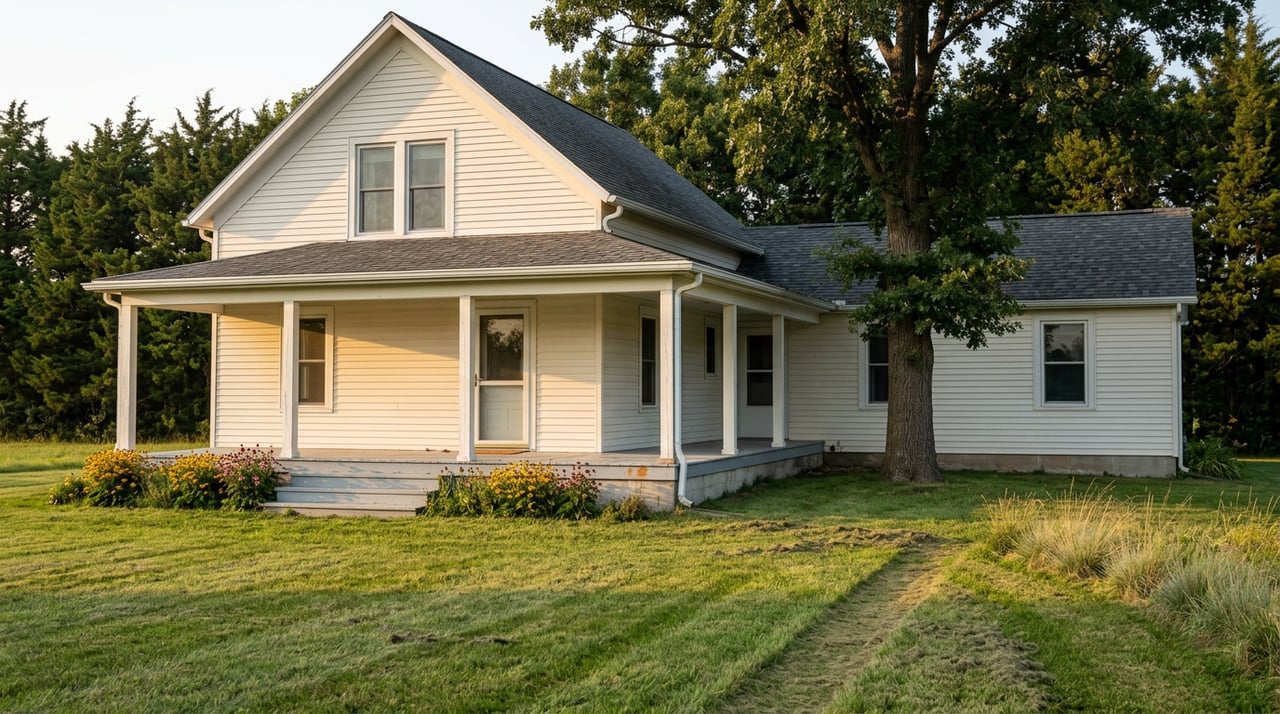
You are three weeks from closing on a place outside Wahoo or Yutan, the kind of property with room for a garden, maybe a couple of horses, definitely a private well. The seller hands over the Nebraska Seller Property Condition Disclosure Statement, the form state law requires before you sign a purchase agreement. You read it looking for reassurance about the water. There isn't any. Not because the seller is hiding something. Because, as NRDnet explains, the law never asked them to find out.
That gap is the thing worth understanding before you write an offer on rural or acreage property in Saunders County, and it matters more here than it does in most Nebraska counties, for reasons tied to the ground the county sits on.
What the disclosure form actually promises you
Nebraska law, under Neb. Rev. Stat. § 76-2,120, requires the seller of any residential property with one to four dwelling units to complete a written disclosure statement before the buyer is bound to purchase. The form covers structural conditions, environmental conditions, title conditions, and a section on cleaning and servicing history. It is a real legal requirement, enforced through the court system rather than the Nebraska Real Estate Commission.
But the statement discloses only what the seller already knows on the date they sign it. The Nebraska Real Estate Commission's disclosure form is explicitly not a warranty, and Nebraska law is clear that it should not be treated as a substitute for an inspection the buyer wants to obtain. A seller who has lived on the property for fifteen years and never had the well tested has nothing to disclose about water quality.
That distinction, between what a seller must disclose and what a seller must know, is where most of the friction in an acreage transaction actually lives.
Why the gap is wider on private wells than almost anywhere else
Municipal systems have to test regularly and report results in an annual Consumer Confidence Report. A private well owner can go their entire ownership without a single water sample, and state agencies confirm this is common. Roughly 400,000 Nebraskans get their drinking water from domestic wells.
Saunders County sits inside the geology that makes this a live concern rather than a theoretical one. The county's low rolling hills slope toward the Platte River, which borders it to the north and east, and the shallow alluvial aquifers along the Platte River valley and the Todd Valley were the first groundwater sources developed in the county and remain among the most closely studied. The University of Nebraska-Lincoln's Groundwater Atlas of Saunders County includes a dedicated map of nitrate concentration in county wells, a level of local documentation most Nebraska counties don't have. The Lower Platte North Natural Resources District also manages a Butler-Saunders Special Quantity Subarea covering roughly 30 square miles of west-central Saunders County, evidence that regulators already treat this ground as one requiring closer attention than average.
The numbers behind the concern
Between November 2023 and March 2024, the Nebraska Department of Environment and Energy ran the state's largest-ever effort to test registered domestic wells, mailing postcards to nearly 29,000 households with instructions for a free test. The results, reported in early 2025, found that 40 percent of private wells tested contained nitrate above 3 parts per million, a threshold one Nebraska medical expert considers the safe ceiling for children, and about 15 percent exceeded the federal drinking water standard of 10 parts per million, the level that would trigger mandatory treatment if it were a public system. The report specifically named the Platte River Valley, alongside the Elkhorn River Valley and the Republican and Blue River basins, as one of the areas where private wells face the most severe nitrate threat.
What stands out isn't just the contamination rate. It's how few well owners actually checked. Out of nearly 29,000 households contacted, only 3,478 samples came back for analysis.
Nebraska Public Media reported that Tim Gragert, a former state senator from Creighton whose town built one of the first complex water treatment plants in Nebraska specifically to filter nitrate, said people out in rural areas "aren't getting educated enough... on the actual severity of this nitrate problem."
Nitrate at high levels causes methemoglobinemia, known as blue baby syndrome, a documented risk for infants. Nitrate can't be seen, smelled, or tasted, which is exactly why a disclosure form built on a seller's personal knowledge will rarely catch it.
What to actually order before you close
If a Saunders County property comes with a private well or a septic system, the disclosure statement is a starting point, not a stopping point. Here's what fills the gap the form leaves open:
- Nitrate and coliform testing. The Nebraska Department of Health and Human Services Public Health Environmental Lab sells nitrate sample kits for $16 and coliform bacteria kits for up to $17. Some Natural Resources Districts and county health departments also offer free or reduced-cost strips, though lab testing is more reliable than paper strips.
- A septic inspection from an NDEE-certified inspector. Certification categories include installer, soil evaluator, inspector, and pumper, all licensed through the state. An inspection typically documents tank condition, system age, and design flow based on bedroom count.
- A well flow and mechanical check, especially if the well may be shared with or accessed through an adjoining property, which is common enough on Nebraska acreages that easement language deserves its own read before closing.
| Item | Typical source | Approximate cost |
|---|---|---|
| Nitrate test kit | NE DHHS Public Health Environmental Lab | $16 |
| Coliform bacteria kit | NE DHHS Public Health Environmental Lab | up to $17 |
| Septic inspection | NDEE-certified inspector | Varies by system size |
| Well flow/mechanical check | Licensed well contractor | Varies by depth and access |
All of it is the difference between a signed disclosure and an informed purchase.
If a test comes back high
According to the Nebraska Department of Environment and Energy, Nebraska's Reverse Osmosis Rebate Program, administered by the state (now under the Department of Water, Energy, and Environment following a 2025 merger of the former Department of Natural Resources), has offered up to $4,000 in rebates. Program terms and open application windows have shifted over time, so anyone considering it should confirm current status directly with the state rather than relying on a prior year's deadline. The state's own March 2026 Governor's Water Quality and Quantity Task Force report lists supporting private well owners as a named goal, which suggests this stays a live policy question rather than a closed one.
What this means at today's price point
Saunders County home prices came in at a median of $473,000 over the three months ending May 2026, up 43.3 percent from the same period a year earlier, with homes averaging 41 days on market and 22 sales closing in May alone. At that price, a $16 nitrate kit and a certified septic inspection are a rounding error against the purchase. Skipping them because a signed disclosure form felt like enough is the expensive version of that math, not the cheap one.
Frequently asked questions
How should testing costs be handled? Address who arranges and pays for testing or inspection in the purchase agreement.
What if the Saunders County property is on rural water instead of a private well? Then the private well testing gap doesn't apply. Rural and municipal systems are required to test regularly and provide an annual Consumer Confidence Report on request.
How fast do nitrate results come back? Testing through the state lab involves mailing a sample and waiting for lab processing, so buyers should build a few weeks of lead time into their inspection period rather than ordering a test the week before closing.
Buying acreage in Saunders County means buying into ground the state already watches closely, for reasons that show up in water tables, not listing photos. If you're comparing properties on either side of the Missouri or the Platte and want someone who reads the disclosure form the same way they read the soil map, Lisa Zimmerman has spent her career in exactly that overlap. Let's Connect before you write the offer, not after.
This article is general information, not legal, tax or financial advice. Consult a qualified professional about your situation.